
Introduction
The Idlib region suffered from power outages from the Zayzoun Dam in Hama after it fell out of regime control in 2015. This forced residents to rely on diesel generators despite the high cost and environmental pollution. Consequently, the search for alternative options began, such as solar energy, whose use saw a significant increase after 2018.
After 2020, the Green Energy company imported electricity from Turkey and connected it to the public grid at relatively high prices for domestic, commercial, and industrial consumption ([1]). With the population’s increasing reliance on solar energy for homes, agricultural projects, and the operation of drinking water stations, wells, and laboratories, the company opened the door to investment in solar farms aimed at producing energy and selling it to the company for a specific financial return. This created an opportunity and space to attract investment and invest in this local model for profit, under contracted terms with the company.
Reverse-transferring electricity from solar farms to the public grid has contributed to Idlib’s self-sufficiency during peak hours, from 9 a.m. to 3 p.m., reducing electricity consumption costs for industrialists, merchants, and households, while reducing the amount of electricity imported from Turkey. It also opens the door to exporting surplus electricity to other regions when conditions permit.
This report seeks to examine Idlib’s experience with solar farms from several perspectives: the role of solar energy in providing a sustainable source of electricity in northwestern Syria, reducing reliance on electricity imported from Turkey or generated by diesel generators, and reducing reliance on polluting, unclean energy. The report also reviews solar energy’s contribution to lowering electricity prices and improving living conditions. Furthermore, it highlights the potential for strengthening the legal framework for investment in the region by engaging with hundreds of suppliers and investors, regulating disputes related to investing companies, their liquidation, and the transfer of ownership, and how these projects can enhance the local economy in the region.
A Model for Solar Energy Use in Idlib
Alternative energy projects, particularly solar energy, have increased significantly in Idlib since 2020, thanks to a number of factors that have encouraged investors to engage in this sector. These factors include the import of electricity from Turkey through the Green Energy Company, which was granted a monopoly to be the sole provider of public electricity in Idlib. The implementation of reverse electricity transmission from solar farms requires the availability of public electricity, and the company guarantees the purchase of the energy generated by the farms.
The decline in military operations in Idlib, on the one hand, and the dominance of Hay’at Tahrir al-Sham (HTS) over the security and economic governance of the region, on the other, have contributed to a state of relative stability and an encouraging environment based on a legal and judicial system that guarantees the rights of capital and investors. Another factor is the ability to import the project’s primary requirements, including panels, transformers, and cables, through the Bab al-Hawa crossing.
All of these factors, in addition to the rapid recovery of project capital, have encouraged hundreds of venture capitalists to enter and invest in this sector. These projects generate profits of between 35-40% annually. A project that costs $100,000 and is fully operational throughout the year can generate income of approximately $25,000 annually (25% annually) after deducting operating costs, breakdowns, and depreciation, i.e., capital is recovered after approximately 4 years from the launch of the project ([2]).
Initially, the company set the minimum production capacity for licensing at approximately 50 kilowatts per day, later raising the limit to 500 kilowatts. After connecting all areas of Idlib to this system and distributing its production throughout the governorate, self-sufficiency was achieved during peak hours from 9 a.m. to 3 p.m., during which time electricity imports from Turkey ceased. Following the overwhelming demand for investment in these projects, the company halted issuing new licenses due to the saturation caused by limited consumption in the region and the inability to sell outside Idlib, whether to regime-controlled areas, Turkey, or rural Aleppo ([3]).
Investing in solar farms requires several key elements ([4]), including:
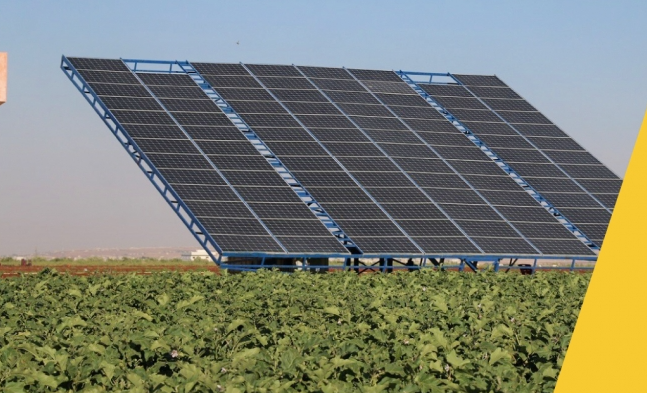
Adequate and suitable land area: Each solar panel requires three square meters. The cost of renting an area of 10 dunams is approximately $1,500 annually for three or seven years, depending on the duration of the investment contract. The company has guaranteed, under the investment contracts, that it will supply electricity from these projects for a period of three years for projects with a production capacity of less than 500 kilowatt-hours, and seven years for those with a production capacity of more than 500 kilowatt-hours. Due to the decrease in electricity prices following the implementation of these projects, the electricity company extended the contract period by two additional years, making the three-year period five years and the five-year period seven years.
Solar panels: The project requires a large number of solar panels. For example, for a system consisting of 1,000 panels, a new panel with a capacity of 550 watts costs $75, while a used panel with a capacity of 190 watts costs $25. It also requires four inverters with a capacity of 110 kilowatts, at a cost of $16,000. Other supplies, such as cables, circuit breakers, and metal structures, are estimated to cost approximately $10,000. The presence of a medium-voltage line near the project: This aims to connect solar-generated electricity to the public grid and reduce the costs of laying cables and installing transformers. Since the beginning of 2021, Green Energy has equipped seven stations to receive high-voltage lines from the Turkish side with a capacity of 66 kilovolts, in addition to equipping medium-voltage lines.
Provision of a special electrical transformer and inverter: A special electrical transformer with a capacity of 400 or 630 kilowatt-hours is required, as well as a special inverter to activate the reverse-pull technology to the public grid. This inverter has three poles (two positive and one negative). The company has specified specific inverter brands for investors: HAUAWEI, GROW WATT, SAN CORCE, SOLIS, CASTER, and DEYE. The cost of an inverter with a capacity of 40 to 125 kilowatts ranges from $2,800 to $4,000. Connecting the solar system to the public grid: The company charges fees for connecting the solar system to the public grid. The average cost of connecting a 100-kilowatt project is estimated at approximately $5,000.